Retail is the most demanding branding environment we work in. A supermarket like Indbazaar does not run one campaign a quarter — it runs one a week. Weekend offers, festival pushes, app-delivery launches, new-store openings, food-fact social posts. Every single one needs design, and every single one is urgent.
The naive answer is a designer on call, making every poster from scratch. It produces inconsistent work at unsustainable speed. The better answer is what we built instead: a campaign system — a small set of rules and templates that make every new piece fast to produce and impossible to get badly wrong.
The poster grid comes first
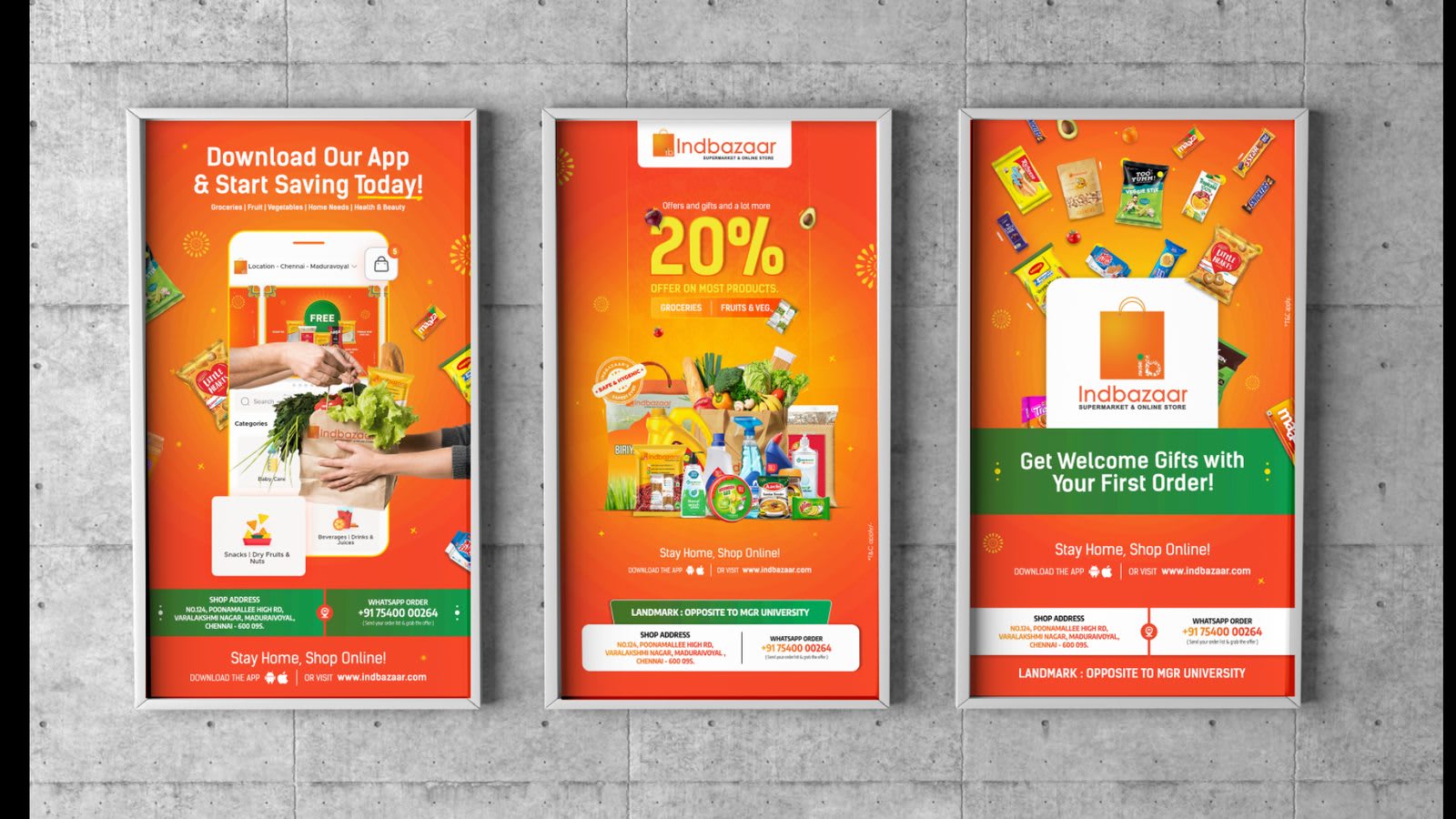
Every Indbazaar offer poster shares one skeleton: the brand block in a fixed corner, one hero product or dish, one oversized price or percentage, and a strip for terms. The excitement changes — the structure never does. That fixed skeleton is why a wall of ten offers still reads as one brand instead of a jumble of discounts.

Festivals are scheduled creativity
Diwali, Pongal, Women’s Day, back-to-school — the retail calendar is known a year in advance, so we treat festival creative as a planned product line, not an emergency. Each festival gets a key visual and a palette shift that sits on top of the same grid. The brand flexes for the occasion without ever changing its bones.

A campaign system is what lets a two-person team ship a year of retail creative without the brand falling apart.
The brand leaves the store
Delivery changed what a supermarket brand is. Half of Indbazaar’s impressions now happen on the street and in the app, not in the aisle — so the system extends to van livery, delivery-app banners, and a food-fact social series that keeps the feed alive between offers. Same grid, same voice, new surfaces.

What made the system stick
- Templates live as editable files with locked brand layers — speed without drift.
- One-page rules: logo zone, type scale, photo treatment, and what never changes.
- A festival calendar agreed a season ahead, so nothing is designed in a panic.
- Every new piece is checked against the wall, not in isolation.
- The system is allowed to evolve — but by decision, not by accident.
The measure of a retail campaign system is not how the first poster looks. It is whether the fiftieth one — made months later, in a hurry, for a festival nobody briefed — still looks like the brand. That is what an engine buys you.